
Businesses today are under constant pressure to do more with less. Customers expect instant responses, employees spend hours on repetitive tasks, and companies need efficient ways to scale operations. This is where AI Chatbot Development is making a significant impact.
From answering customer questions to automating workflows, AI chatbots are helping businesses save time, reduce costs, and improve customer experiences. Whether you’re a startup, small business, or large enterprise, investing in AI-powered chatbots can help streamline operations and drive growth.
In this guide, we’ll explore how AI chatbot development works, its benefits, the development process, tools, and how businesses can leverage chatbots for automation.
What Is AI Chatbot Development?
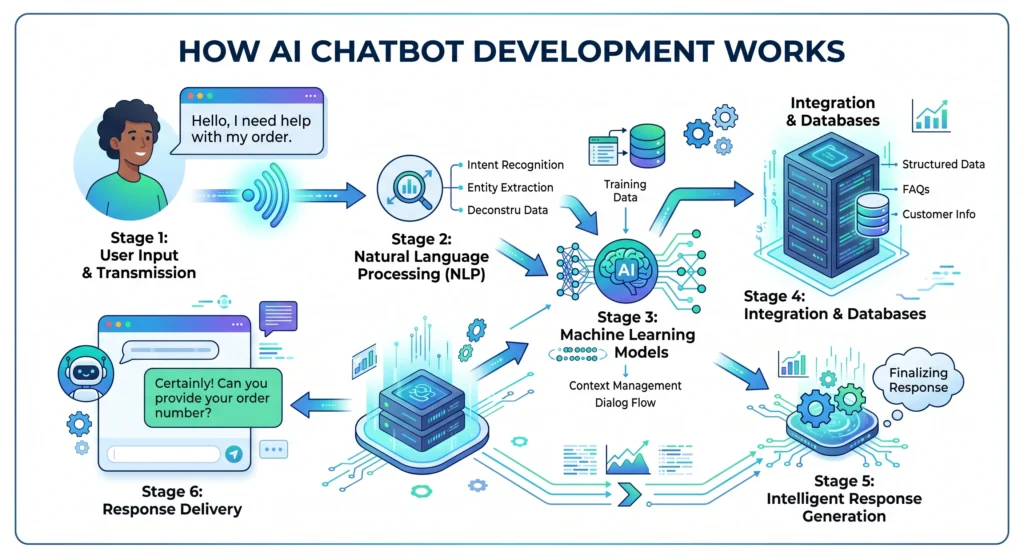
AI Chatbot Development is the process of designing, building, training, and deploying intelligent chatbots that can interact with users through natural language. Unlike traditional rule-based chatbots, AI chatbots use machine learning, natural language processing (NLP), and artificial intelligence to understand user intent and provide relevant responses.
Modern AI chatbots can:
- Answer customer inquiries instantly
- Automate support requests
- Generate leads
- Schedule appointments
- Assist with internal business operations
- Provide personalized recommendations
As AI technology continues to evolve, businesses are increasingly adopting AI chatbots to automate repetitive tasks and improve efficiency.

Why Businesses Need Chatbot Development
Customer expectations have changed dramatically over the past few years. People want answers immediately, regardless of the time or day.
Here are some reasons businesses are investing in AI Chatbot Development:
1. 24/7 Customer Support
Unlike human agents, AI chatbots never sleep. They can answer customer questions around the clock, ensuring users receive immediate assistance whenever they need it.
2. Reduced Operational Costs
Hiring and training customer support teams can be expensive. AI chatbots handle thousands of conversations simultaneously, reducing the need for large support teams.
3. Improved Customer Experience
Fast responses improve customer satisfaction. AI chatbots help customers find information quickly without waiting in long support queues.
4. Increased Productivity
Employees often spend valuable time answering repetitive questions. AI chatbots automate these interactions, allowing teams to focus on more strategic work.
5. Better Lead Generation
AI chatbots can qualify leads, collect contact information, and guide potential customers through the sales funnel automatically.
Key Benefits of Chatbot Development for Business Automation
The biggest advantage of AI Chatbot Development is automation. Businesses can automate numerous processes without sacrificing customer experience.
Some common use cases include:
Customer Service Automation
Chatbots can handle FAQs, product inquiries, order tracking, refund requests, and troubleshooting tasks.
Sales Automation
AI chatbots engage website visitors, recommend products, and collect lead information for sales teams.
HR Automation
Many companies use chatbots to answer employee questions regarding policies, leave requests, and onboarding procedures.
Appointment Scheduling
Chatbots can automatically schedule meetings, consultations, and service appointments.
E-commerce Assistance
Online stores use chatbots to guide shoppers, recommend products, and assist during checkout.
AI Chatbot Development Process
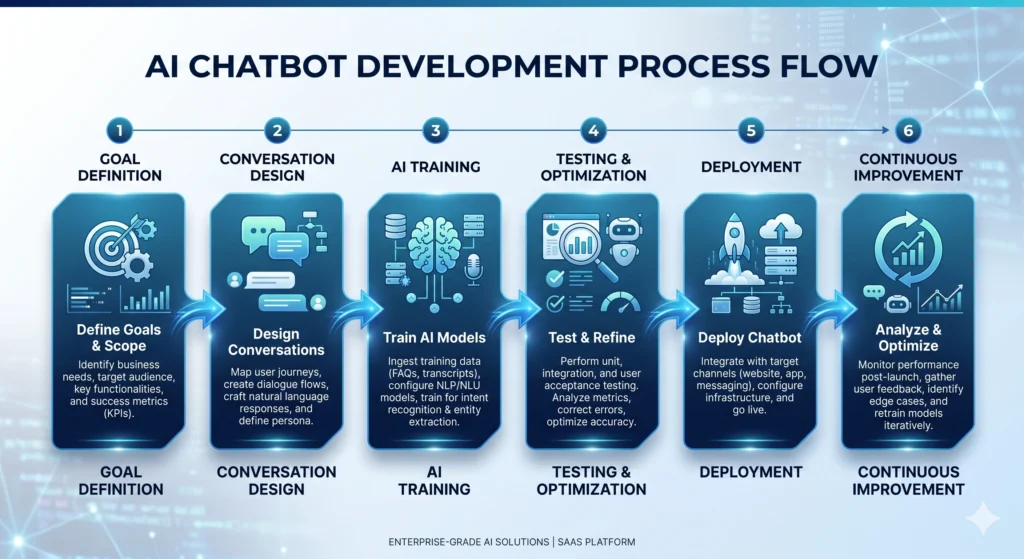
Understanding the AI chatbot development process is important before launching a chatbot project.
Step 1: Define Objectives
Determine what the chatbot should accomplish. Common goals include customer support, lead generation, sales assistance, or internal automation.
Step 2: Identify User Needs
Analyze customer pain points and frequently asked questions. This helps create a chatbot that provides real value.
Step 3: Choose the Right Technology
Select suitable AI models, NLP frameworks, and chatbot platforms based on your requirements.
Step 4: Design Conversation Flows
Create conversational pathways that guide users toward desired outcomes.
Step 5: Train the AI Model
Train the chatbot using relevant data, FAQs, documents, and customer interactions.
Step 6: Testing and Optimization
Test chatbot responses extensively to identify issues and improve performance.
Step 7: Deployment and Monitoring
Deploy the chatbot on websites, mobile apps, WhatsApp, Facebook Messenger, or other channels and continuously monitor performance.
Best Chatbot Development Tools
Choosing the right AI chatbot development tools can significantly impact chatbot performance and scalability.
Popular tools include:
- Google Dialogflow
- Microsoft Bot Framework
- IBM Watson Assistant
- OpenAI API
- Rasa
- Botpress
- Amazon Lex
- Chatfuel
These tools simplify chatbot creation and help businesses deploy intelligent conversational experiences faster.
Choosing an AI Chatbot Development Company
Many businesses prefer working with an experienced chatbot development company instead of building solutions internally.
When selecting a development partner, consider:
- Industry experience
- Portfolio of chatbot projects
- AI and NLP expertise
- Integration capabilities
- Post-launch support
- Pricing and scalability
A reliable company can help businesses avoid costly mistakes and accelerate implementation.
Chatbot Development Services Businesses Commonly Need
Professional AI chatbot development services often include:
- Custom chatbot development
- Conversational AI consulting
- NLP integration
- Chatbot UI/UX design
- API integration
- CRM integration
- Chatbot maintenance
- Analytics and reporting
These services ensure chatbots deliver meaningful business results.
How to Make Your Own Chatbot for Free
Many entrepreneurs and students ask, “How to make your own AI chatbot for free?”
The good news is that several platforms offer free plans for experimentation.
You can:
- Choose a free chatbot platform like Botpress or Dialogflow.
- Create an account.
- Define chatbot objectives.
- Design conversation flows.
- Train the chatbot using sample data.
- Test interactions.
- Deploy it on a website or messaging platform.
Free tools are ideal for learning and building simple chatbot prototypes before investing in advanced solutions.
Google Chatbot Subscription: Is It Worth It?

With the rise of generative AI, many businesses are exploring options like a Google AI chatbot subscription.
Google offers AI-powered solutions through Gemini and related enterprise services that provide advanced conversational capabilities.
Benefits may include:
- Enhanced language understanding
- Advanced reasoning capabilities
- Productivity integrations
- Enterprise-grade security
- Scalable AI infrastructure
Businesses should evaluate their needs and compare available AI platforms before choosing a subscription plan.
How to Make a Chatbot in Python
Developers frequently ask, “How to make a AI chatbot in Python?”
Python is one of the most popular programming languages for chatbot development due to its simplicity and extensive AI libraries.
Basic steps include:
Install Required Libraries
Common libraries include:
- NLTK
- Transformers
- TensorFlow
- PyTorch
- OpenAI SDK
Create a Chat Interface
Develop a simple user interface using Flask, FastAPI, or Streamlit.
Process User Input
Use NLP techniques to understand user intent.
Generate Responses
Integrate AI models that generate relevant replies.
Deploy the Chatbot
Host the chatbot on cloud platforms such as AWS, Azure, or Google Cloud.
Python provides flexibility and scalability, making it an excellent choice for AI chatbot projects.
Common Challenges in Chatbot Development
While Chatbot Development offers numerous advantages, businesses should be aware of potential challenges.
Data Quality
Poor training data often results in inaccurate chatbot responses.
Complex User Queries
Handling nuanced or ambiguous questions requires advanced NLP capabilities.
Integration Issues
Connecting chatbots with existing business systems can be technically challenging.
Continuous Improvement
Chatbots require ongoing monitoring and updates to maintain accuracy and effectiveness.
Addressing these challenges early can significantly improve chatbot performance.
The Future of AI Chatbot
The future of AI Chatbot looks incredibly promising. Advances in large language models, machine learning, and conversational AI are enabling chatbots to become more human-like and context-aware.
Future trends include:
- Voice-enabled AI assistants
- Multilingual chatbots
- Emotion recognition
- Hyper-personalized conversations
- AI-powered workflow automation
- Deeper business system integrations
Organizations that adopt conversational AI early will gain a competitive advantage in customer engagement and operational efficiency.
Conclusion
AI Chatbot Development has become one of the most effective ways for businesses to automate operations, improve customer support, and increase productivity. Whether you’re looking to automate customer service, generate leads, or streamline internal processes, AI chatbots offer scalable and cost-effective solutions.
By understanding the AI chatbot development process, selecting the right AI chatbot development tools, and leveraging professional AI chatbot development services, businesses can create intelligent virtual assistants that deliver real value.
As AI technology continues to evolve, companies that invest in chatbot automation today will be better positioned to meet customer expectations and drive long-term growth.