

Artificial Intelligence has moved far beyond simple chatbots and rule-based automation. Today, businesses are exploring Autonomous AI Agents that can make decisions, complete tasks, and continuously improve without requiring constant human guidance.
From customer support and software development to finance and healthcare, these intelligent systems are changing how organizations operate. Instead of simply responding to commands, they can plan, reason, execute, and adapt to different situations.
In this blog, we’ll explain what Autonomous AI Agents are, how they work, where they’re used, and why they’re becoming one of the biggest trends in AI.
What Are Autonomous AI Agents?
AI Agents are AI-powered software systems that can understand goals, make decisions, perform actions, and learn from results with minimal human intervention.
Unlike traditional AI tools that only respond to prompts, these agents can:
- Analyze situations
- Create action plans
- Use external tools
- Access databases
- Communicate with other systems
- Improve future decisions based on feedback
Think of them as digital employees that can complete entire workflows instead of individual tasks.
For example, instead of asking an AI to write a single email, an autonomous agent can:
- Read customer inquiries
- Search company documents
- Draft responses
- Send follow-up emails
- Schedule meetings
- Update the CRM automatically
This level of automation is why businesses are investing heavily in Autonomous AI Agents.
How AI Agents Work
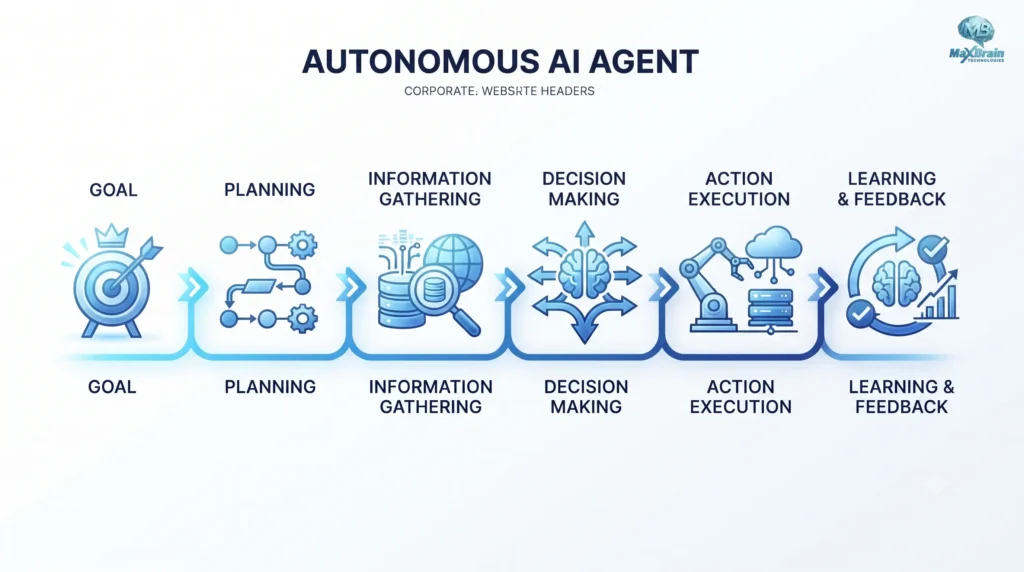
Understanding how Autonomous AI Agents work becomes easier when you break the process into simple steps.
1. Goal Understanding
Everything begins with a goal.
For example:
- Resolve customer complaints
- Generate monthly reports
- Optimize inventory
- Monitor cybersecurity threats
The AI first understands what success looks like.
2. Planning
Instead of immediately taking action, the agent creates a strategy.
Example:
Customer asks for an order refund.
The AI may decide to:
- Check purchase history
- Verify refund eligibility
- Review company policy
- Create refund request
- Notify customer
Planning is what separates intelligent agents from simple automation.
3. Information Gathering
The agent collects relevant information from different sources.
These may include:
- Databases
- APIs
- Company documents
- CRM software
- Internet resources
- Internal knowledge bases
The better the information, the smarter the decision.
4. Decision Making
Using machine learning and large language models (LLMs), the AI evaluates multiple options.
It compares:
- Risk
- Accuracy
- Business rules
- Previous outcomes
- User preferences
Then it selects the best action.
5. Action Execution
Now the AI performs the task.
Examples include:
- Sending emails
- Updating records
- Creating reports
- Booking appointments
- Running software
- Executing workflows
Unlike traditional chatbots, the AI actually completes work.
6. Learning From Results
The biggest advantage of AI Agents is continuous improvement.
They learn from:
- User feedback
- Task success
- Errors
- Historical data
- Performance metrics
This makes future decisions smarter.
Key Components of AI Agents
Most Autonomous AI Agents contain several important components.
Large Language Models
LLMs help agents understand natural language, generate responses, summarize documents, and reason through problems.
Popular models include GPT, Claude, Gemini, and Llama.
Memory
Memory enables agents to remember previous conversations, completed tasks, customer preferences, and business rules.
Without memory, every interaction would start from scratch.
Planning Engine
The planning engine decides:
- What to do first
- Which tools to use
- Which actions depend on others
- When to stop
This makes the workflow organized.
Tool Integration
Modern AI agents connect with:
- Email platforms
- CRM software
- ERP systems
- Databases
- Cloud storage
- APIs
This allows them to work like real employees.
Feedback Loop
Every completed task becomes new learning material.
The feedback loop continuously improves future performance.
Real-World AI Agents Examples
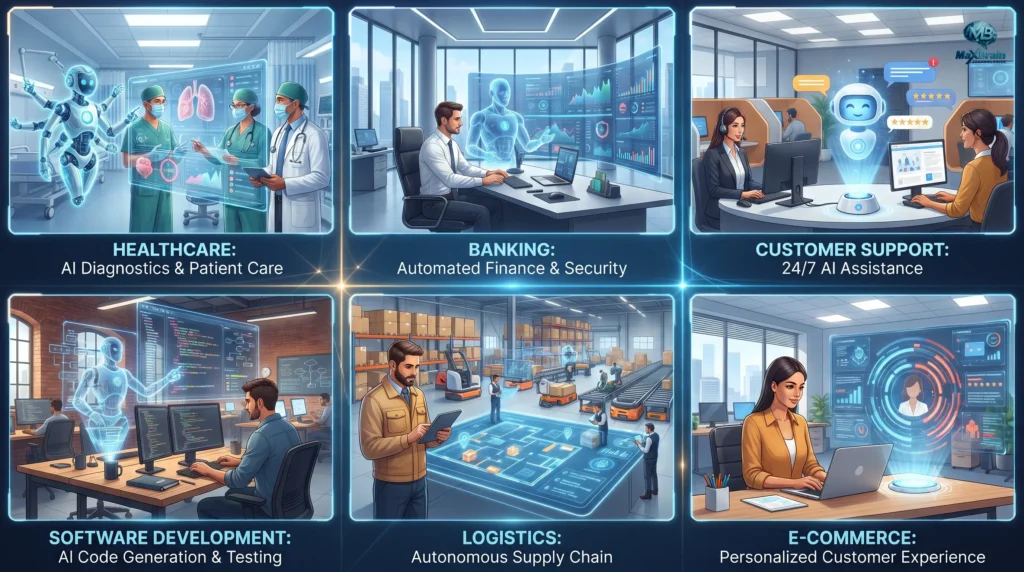
Many businesses already use Autonomous AI Agents in daily operations.
Customer Support
AI agents:
- Answer customer questions
- Process refunds
- Escalate complex issues
- Track complaints
- Generate tickets
Support becomes available 24/7.
Healthcare
Hospitals use AI agents for:
- Appointment scheduling
- Patient monitoring
- Medical documentation
- Clinical assistance
- Insurance verification
Healthcare professionals save valuable time.
Software Development
Developers use AI agents to:
- Write code
- Review pull requests
- Detect bugs
- Generate documentation
- Test applications
This speeds up software delivery.
Finance
Banks deploy AI agents for:
- Fraud detection
- Loan verification
- Expense analysis
- Compliance checks
- Financial reporting
Automation reduces operational costs.
Supply Chain
Manufacturers use AI agents for:
- Inventory management
- Demand forecasting
- Shipment tracking
- Warehouse optimization
- Vendor communication
Operations become more efficient.
Benefits of Autonomous Agents
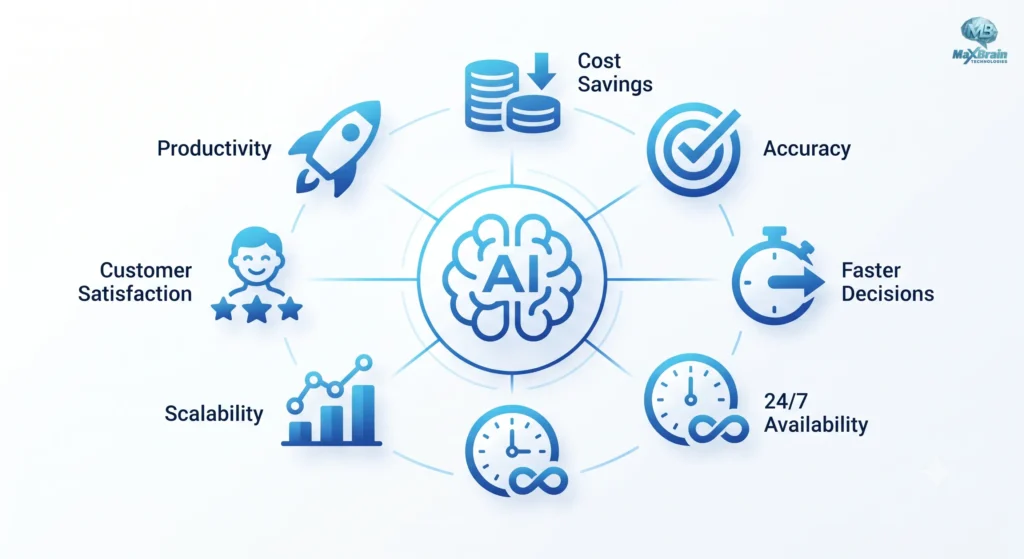
Organizations are adopting AI Agents because they provide significant business value.
Higher Productivity
Routine tasks are completed automatically, allowing employees to focus on strategic work.
Faster Decision Making
AI analyzes large datasets within seconds.
This reduces delays.
Reduced Costs
Automation lowers operational expenses while increasing efficiency.
Better Customer Experience
Customers receive instant, personalized assistance around the clock.
Improved Accuracy
AI minimizes human errors in repetitive processes.
Easy Scalability
Businesses can manage thousands of tasks simultaneously without hiring additional staff.
Challenges:
Although powerful, Autonomous AI Agents also have limitations.
Data Quality
Poor-quality data leads to poor decisions.
Organizations must maintain clean and accurate datasets.
Security Risks
Agents often access sensitive business information.
Strong cybersecurity measures are essential.
Ethical Concerns
Questions remain about:
- Accountability
- Privacy
- Bias
- Transparency
These concerns continue to shape AI regulations.
Human Oversight
Autonomous does not mean unsupervised.
Humans should still monitor critical business decisions.
Autonomous AI Agents vs Agentic AI
Many people confuse AI Agents with Agentic AI.
Although related, they are not identical.
| Autonomous AI Agents | Agentic AI |
|---|---|
| Individual intelligent agents | Broader AI framework |
| Executes specific goals | Coordinates multiple agents |
| Focuses on task completion | Focuses on end-to-end reasoning |
| Can work independently | Often manages several autonomous agents |
| Ideal for workflow automation | Ideal for enterprise decision-making |
In simple terms, autonomous agents are often the building blocks of larger agentic AI systems.
Popular AI Agent Frameworks
Businesses and developers have several options when building AI agents.
Some popular frameworks include:
- LangGraph
- CrewAI
- AutoGen
- Semantic Kernel
- OpenAI Agents SDK
- Haystack Agents
These frameworks simplify planning, memory, tool usage, and collaboration between multiple AI agents.
AI Agents GitHub Projects
Developers searching for AI Agents GitHub repositories will find many open-source projects that demonstrate planning, multi-agent collaboration, task execution, and workflow automation.
Popular categories include:
- AI coding assistants
- Research agents
- Browser automation agents
- Multi-agent orchestration
- Workflow automation
- Personal productivity assistants
Studying open-source projects is one of the best ways to understand how modern AI agents are built.
AI Agents Companies
Many technology companies are investing heavily in AI Agents.
Some well-known names include:
- OpenAI
- Anthropic
- Microsoft
- NVIDIA
- Oracle
- Salesforce
- IBM
These companies are integrating AI agents into productivity software, enterprise applications, customer service platforms, and cloud ecosystems.
Autonomous Agents in Ethics
As AI becomes more independent, ethical questions become increasingly important.
Some major concerns include:
- Should AI make critical business decisions?
- Who is responsible if an AI makes a mistake?
- How should personal data be protected?
- Can AI decisions be fully explained?
- How do we prevent bias?
Responsible AI governance, transparency, and human oversight remain essential when deploying autonomous systems.
AI Agents Claude
Many organizations are also exploring Autonomous AI Agents Claude solutions built on Anthropic’s Claude models.
Claude is commonly used for:
- Enterprise knowledge assistants
- Long-document analysis
- Coding support
- Customer service
- Research automation
Its large context window makes it particularly useful for handling complex business workflows.
Which Capability Is Focused on AI Agents in Oracle Fusion?
A common question businesses ask is: Which capability is focused on autonomous AI agents in Oracle Fusion?
Oracle Fusion uses AI agents to automate enterprise workflows such as finance, HR, procurement, supply chain, and customer experience. These capabilities help users complete business processes with minimal manual effort by combining intelligent recommendations, workflow automation, and contextual decision-making.
The Future of Autonomous Agents
The next generation of Autonomous AI Agents will become even more capable.
Future improvements may include:
- Better long-term memory
- Stronger reasoning abilities
- Improved collaboration between multiple agents
- Real-time learning
- Industry-specific intelligence
- Enhanced security and governance
Businesses will increasingly rely on AI agents to automate complex operations while employees focus on creativity, innovation, and strategic planning.
Conclusion
AI Agents are transforming how businesses automate work, make decisions, and improve productivity. Unlike traditional AI tools, they don’t simply answer questions—they plan, execute tasks, learn from outcomes, and adapt over time.
Whether it’s customer service, software development, healthcare, finance, or supply chain management, these intelligent systems are helping organizations work faster and more efficiently. As AI technology continues to evolve, Autonomous AI Agents will play an even bigger role in shaping the future of business automation.
Organizations that start exploring AI agents today will be better positioned to improve efficiency, reduce costs, and deliver smarter customer experiences in the years ahead.