
Introduction
Artificial Intelligence is transforming the way businesses operate. From automating repetitive tasks to improving customer experiences, AI is helping organizations become faster, smarter, and more efficient. However, simply purchasing an AI tool isn’t enough. Businesses need the right strategy to connect AI with their existing software, workflows, and business processes. That’s where AI Integration Services become essential.
Whether you’re a startup, SME, or enterprise, integrating AI into your existing systems allows you to unlock automation, reduce manual work, improve decision-making, and increase productivity without replacing your current infrastructure.
In this guide, we’ll explain What is AI integration, how AI integration works, its benefits, real-world applications, implementation process, common challenges, and how to choose the right AI integration partner for your business.
What Are AI Integration Services?
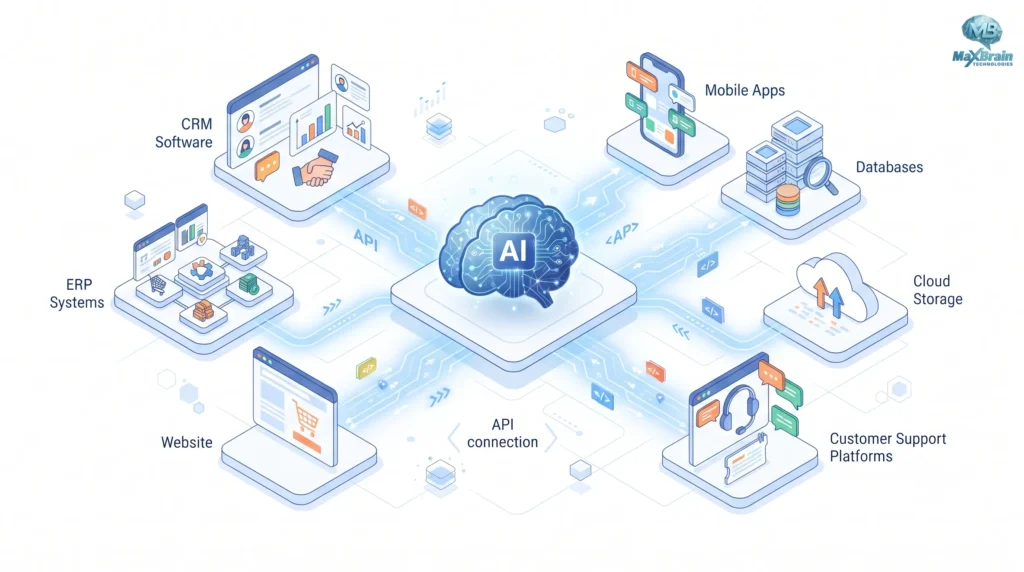
AI Integration Services refer to the process of connecting artificial intelligence technologies with existing business applications, software, databases, websites, mobile apps, CRMs, ERPs, cloud platforms, and internal workflows.
Instead of building everything from scratch, businesses integrate AI capabilities into their current systems to automate operations, analyze data, predict outcomes, and deliver personalized customer experiences.
Professional AI Integration Services ensure seamless communication between AI models and business applications while maintaining security, scalability, and performance.

What is AI Integration?
Many businesses ask, What is AI integration?
AI integration is the process of embedding artificial intelligence capabilities into existing software systems and business operations.
Instead of replacing your current applications, AI enhances them by adding intelligent features such as:
- Natural Language Processing (NLP)
- Machine Learning
- Predictive Analytics
- Computer Vision
- Recommendation Engines
- Voice Recognition
- Intelligent Automation
- Generative AI
For example:
- CRM + AI = Intelligent lead scoring
- ERP + AI = Inventory forecasting
- HR Software + AI = Resume screening
- Customer Support + AI = AI chatbot
- Ecommerce + AI = Personalized product recommendations
Why Businesses Need AI Integration
Most companies already use multiple software platforms. The challenge isn’t adopting AI—it’s making AI work with existing systems.
Professional AI Integration Services help businesses:
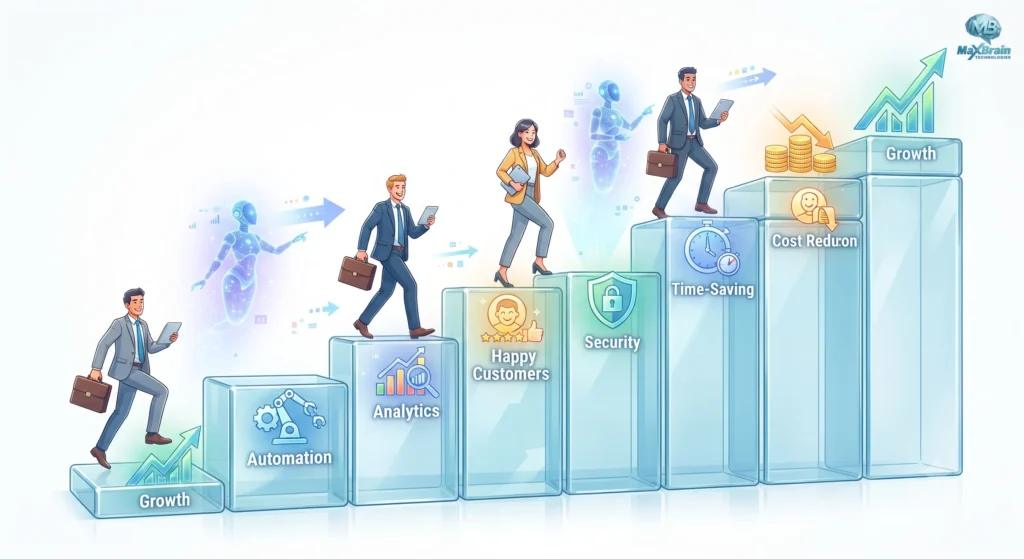
- Automate repetitive tasks
- Improve operational efficiency
- Reduce human errors
- Increase productivity
- Generate business insights
- Enhance customer experiences
- Reduce operational costs
- Make faster business decisions
Instead of changing the entire infrastructure, businesses simply integrate AI into their existing workflows.
Key Benefits of AI Integration
1. Business Process Automation
AI automates repetitive tasks like:
- Data entry
- Invoice processing
- Email categorization
- Appointment scheduling
- Document verification
Employees can focus on higher-value work instead.
2. Better Customer Experience
AI-powered chatbots and virtual assistants provide:
- 24/7 customer support
- Instant responses
- Personalized recommendations
- Faster issue resolution
Customers receive better service while businesses reduce support costs.
3. Data-Driven Decision Making
AI analyzes large datasets within seconds.
Businesses gain insights such as:
- Customer behavior
- Sales trends
- Inventory demand
- Risk predictions
- Market forecasting
4. Increased Productivity
AI reduces manual work across departments including HR, finance, marketing, healthcare, and logistics.
Teams complete tasks faster with fewer errors.
5. Cost Savings
By automating routine processes, organizations reduce operational expenses while improving overall efficiency.
6. Scalability
As your business grows, AI can process increasing amounts of data without requiring proportional increases in workforce.
AI Integration Examples
Here are some practical AI integration examples across industries.
Healthcare
- Medical image analysis
- Patient scheduling
- Clinical documentation
- Disease prediction
- Virtual health assistants
Retail
- Personalized recommendations
- Smart inventory management
- Customer analytics
- Dynamic pricing
- Demand forecasting
Finance
- Fraud detection
- Credit risk assessment
- AI-powered customer support
- Expense automation
- Financial forecasting
Manufacturing
- Predictive maintenance
- Quality inspection
- Supply chain optimization
- Production planning
- Equipment monitoring
Education
- Personalized learning
- Automated grading
- Student performance analysis
- AI tutoring systems
Real Estate
- Property recommendations
- Lead qualification
- Virtual assistants
- Market prediction
- Document automation
Generative AI Integration
One of the fastest-growing trends is Generative AI integration services.
Businesses are integrating advanced language models into their operations for content creation, customer support, coding assistance, knowledge management, and workflow automation.
Common applications include:
- AI chatbots
- AI writing assistants
- Internal knowledge assistants
- Code generation
- Email drafting
- Meeting summaries
- Marketing content creation
- AI-powered search
Generative AI improves productivity while reducing repetitive work across departments.
Popular AI Integration Tools
Selecting the right AI integration tool depends on business goals and existing infrastructure.
Some commonly used tools and platforms include:
- OpenAI APIs
- Google Vertex AI
- Microsoft Azure AI
- Amazon Bedrock
- LangChain
- Zapier AI
- Make (Integromat)
- TensorFlow
- PyTorch
- Hugging Face
- Pinecone
- Weaviate
These tools enable developers to connect AI models with business applications quickly and efficiently.
AI Integration Process
A successful AI implementation follows a structured process.
Step 1: Business Analysis
Understand:
- Current workflows
- Pain points
- Business goals
- Existing software
Step 2: AI Opportunity Identification
Identify where AI can provide measurable improvements.
Examples:
- Customer support
- Marketing
- Sales
- Operations
- HR
- Finance
Step 3: Data Preparation
AI performs best with clean and structured data.
Businesses organize:
- Customer data
- Transaction records
- Product catalogs
- Historical information
Step 4: Model Selection
Choose the right AI model based on business requirements.
This may include:
- Machine Learning
- Generative AI
- Computer Vision
- NLP
- Recommendation systems
Step 5: Integration
Developers connect AI with:
- ERP
- CRM
- Mobile apps
- Websites
- APIs
- Databases
- Internal software
Step 6: Testing
Before deployment:
- Validate outputs
- Measure accuracy
- Improve performance
- Ensure security
Step 7: Deployment & Monitoring
Continuous monitoring ensures AI remains accurate as business data evolves.
Industries Using AI Integration
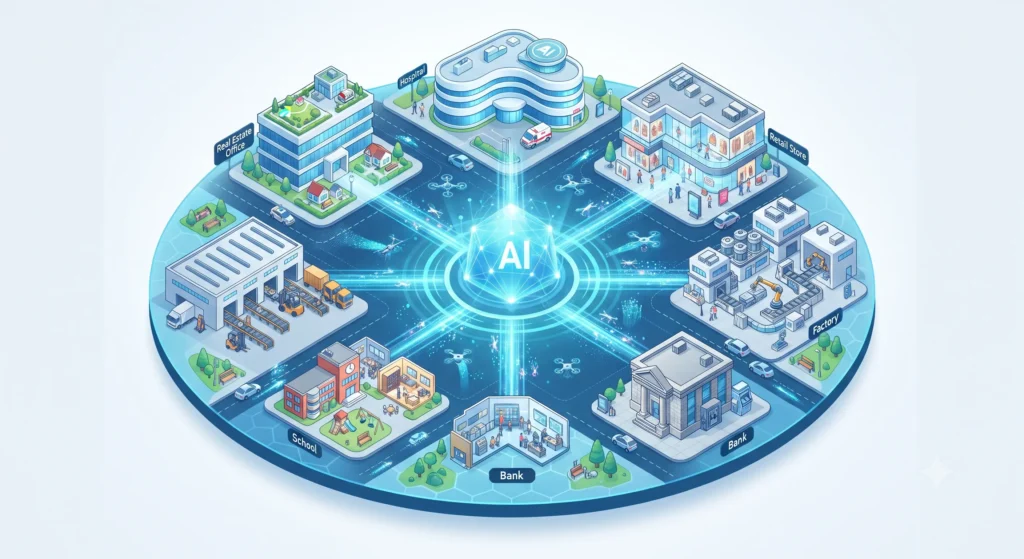
Today, AI Integration Services are being adopted across multiple industries.
These include:
- Healthcare
- Banking
- Insurance
- Retail
- Ecommerce
- Manufacturing
- Logistics
- Education
- Real Estate
- Telecommunications
- Travel
- Hospitality
- Legal
- Human Resources
- Marketing Agencies
Common Challenges During AI Integration
Although AI offers numerous advantages, businesses often face challenges.
Data Quality
Poor-quality data leads to inaccurate AI predictions.
Legacy Systems
Older software may require modernization before AI integration.
Security
Sensitive customer data must remain protected.
Employee Adoption
Organizations should train employees to effectively use AI-powered systems.
Integration Complexity
Connecting multiple systems requires experienced AI engineers.
AI Governance Services
As AI adoption increases, businesses also need strong AI governance services.
AI governance focuses on:
- Responsible AI usage
- Data privacy
- Security
- Regulatory compliance
- Bias reduction
- Risk management
- Model monitoring
- Transparency
Strong governance ensures AI systems remain trustworthy, ethical, and compliant with industry standards.
AI Integration Hyderabad
Businesses looking for AI integration services Hyderabad have access to a growing ecosystem of AI development companies specializing in:
- Custom AI development
- AI chatbot integration
- Workflow automation
- Generative AI implementation
- Enterprise AI solutions
- API integration
- Cloud AI deployment
- AI consulting
Hyderabad has become a leading technology hub, making it an attractive destination for AI innovation.
AI Integration in Gaming
Another interesting application is the AI integration game industry.
Modern games use AI for:
- Intelligent NPC behavior
- Dynamic storytelling
- Personalized gameplay
- Real-time difficulty adjustment
- Procedural content generation
- Voice interaction
- Adaptive game environments
AI is making gaming more immersive and engaging than ever before.
Can You Learn AI Integration?
Absolutely.
Many professionals enroll in an AI integration course to understand:
- Machine Learning basics
- API integration
- Prompt engineering
- Generative AI
- Cloud AI platforms
- Python programming
- Automation workflows
- AI deployment
Learning AI integration opens career opportunities in software development, automation, data science, and AI consulting.
How to Choose the Right Partner
When selecting an AI integration company, consider the following:
Industry Experience
Look for proven experience in your business domain.
Technical Expertise
The team should have expertise in AI, APIs, cloud computing, and software integration.
Security Standards
Ensure the provider follows strong security and compliance practices.
Scalability
Solutions should grow alongside your business.
Post-Deployment Support
Reliable maintenance and optimization are essential for long-term success.
Future of AI Integration
The future of AI Integration Services is centered on intelligent automation and connected ecosystems.
Emerging trends include:
- Autonomous AI agents
- Multi-agent systems
- Hyperautomation
- AI copilots
- Real-time decision intelligence
- Voice AI
- Edge AI
- Industry-specific AI platforms
Businesses that integrate AI today will be better positioned to compete, innovate, and adapt in the years ahead.
Conclusion
Artificial intelligence is no longer a luxury reserved for large enterprises. Businesses of every size can improve efficiency, automate workflows, and deliver better customer experiences through AI Integration Services.
Whether you’re implementing chatbots, predictive analytics, workflow automation, or Generative AI integration services, successful integration allows you to maximize the value of your existing systems instead of replacing them.
As AI continues to evolve, organizations that invest in thoughtful integration, strong governance, and scalable solutions will gain a significant competitive advantage. If you’re planning your AI journey, now is the perfect time to explore how custom AI solutions can transform your business.
Frequently Asked Questions (FAQs)
1. What is AI integration?
AI integration is the process of connecting artificial intelligence technologies with existing business software, applications, and workflows to automate tasks, improve decision-making, and enhance efficiency.
2. What are AI Integration Services?
AI Integration Services help businesses implement, customize, and connect AI solutions with current systems such as CRM, ERP, websites, mobile apps, and cloud platforms.
3. What are Generative AI integration services?
Generative AI integration services involve embedding AI models into business applications for tasks like content generation, customer support, coding assistance, document summarization, and workflow automation.
4. Which industries benefit from AI integration?
Healthcare, finance, retail, manufacturing, education, logistics, real estate, insurance, and eCommerce are among the industries gaining significant value from AI integration.
5. Why are AI governance services important?
AI governance services ensure AI systems remain secure, ethical, compliant, transparent, and reliable while minimizing risks related to privacy, bias, and regulatory requirements.